How Conveyor Speed and Spacing Affect Clamshell Closing Accuracy
Oct 19, 2026
Learn how belt speed, container pitch, and transfer control affect clamshell lid alignment, latch engagement, and closing accuracy.
Closing problems often start before the lid touches a guide
A clamshell enters the closer slightly crooked. One front corner locks, the other stays open, and the operator presses it shut by hand. The first reaction is usually to adjust the closing mechanism. Sometimes that is right. But if the next ten packages close correctly, check how the containers are arriving before changing tooling.
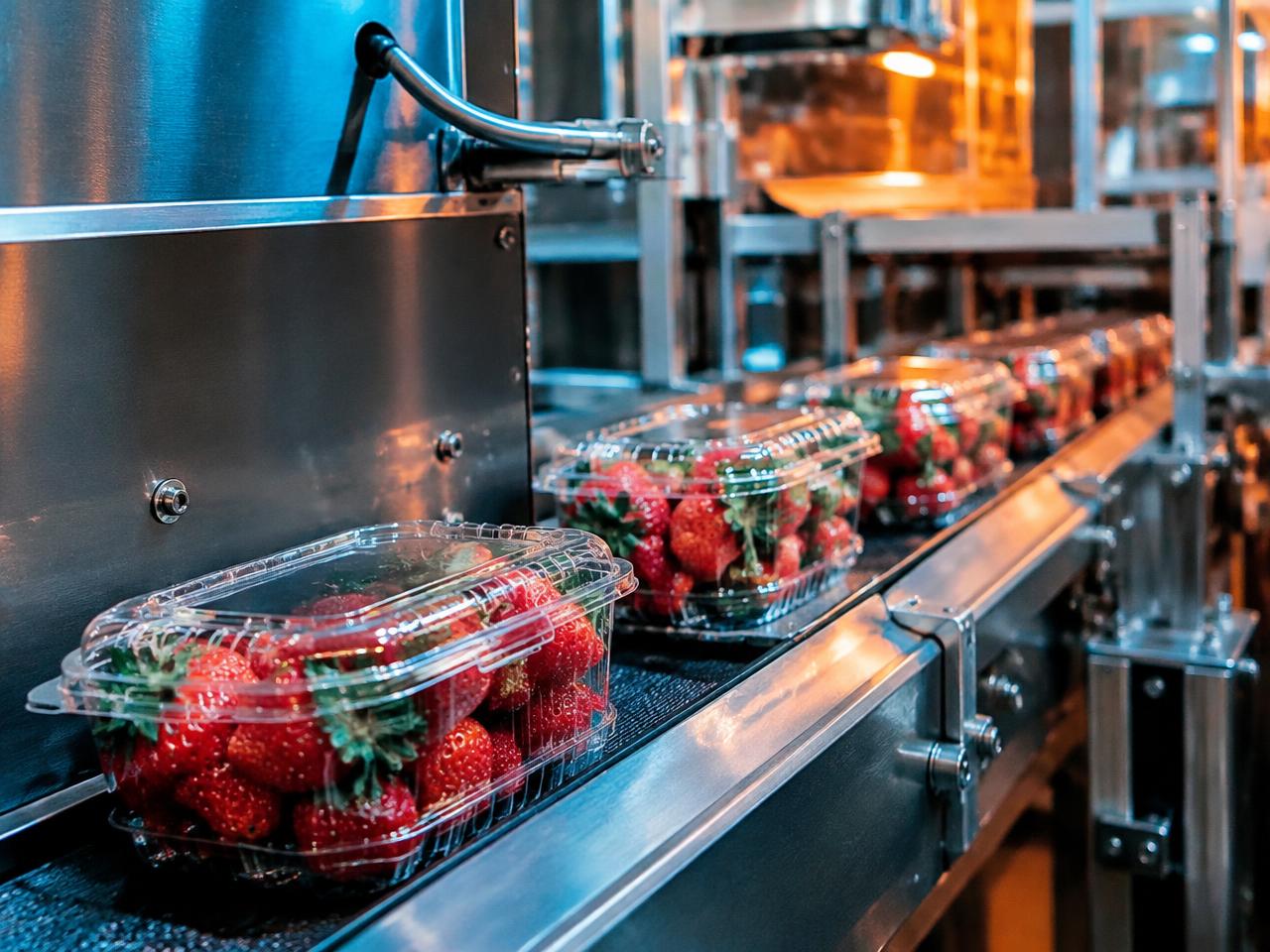
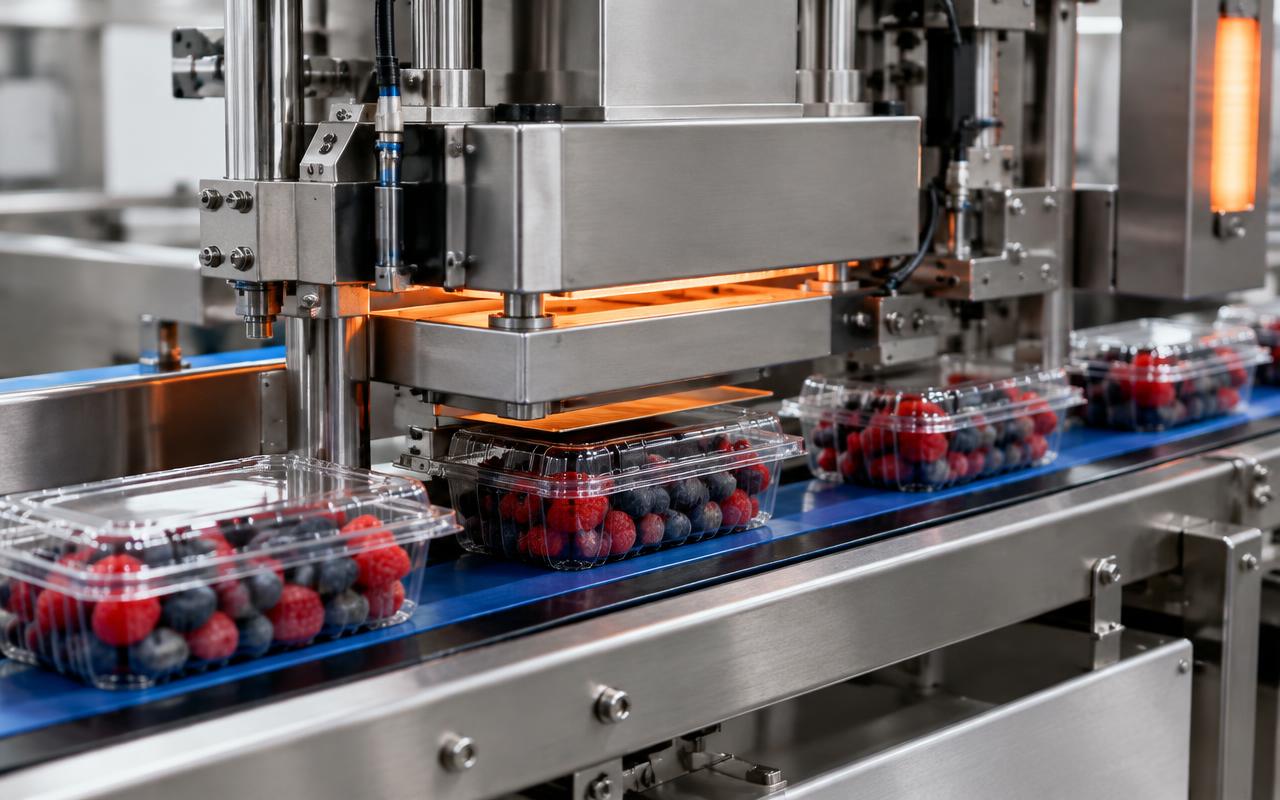
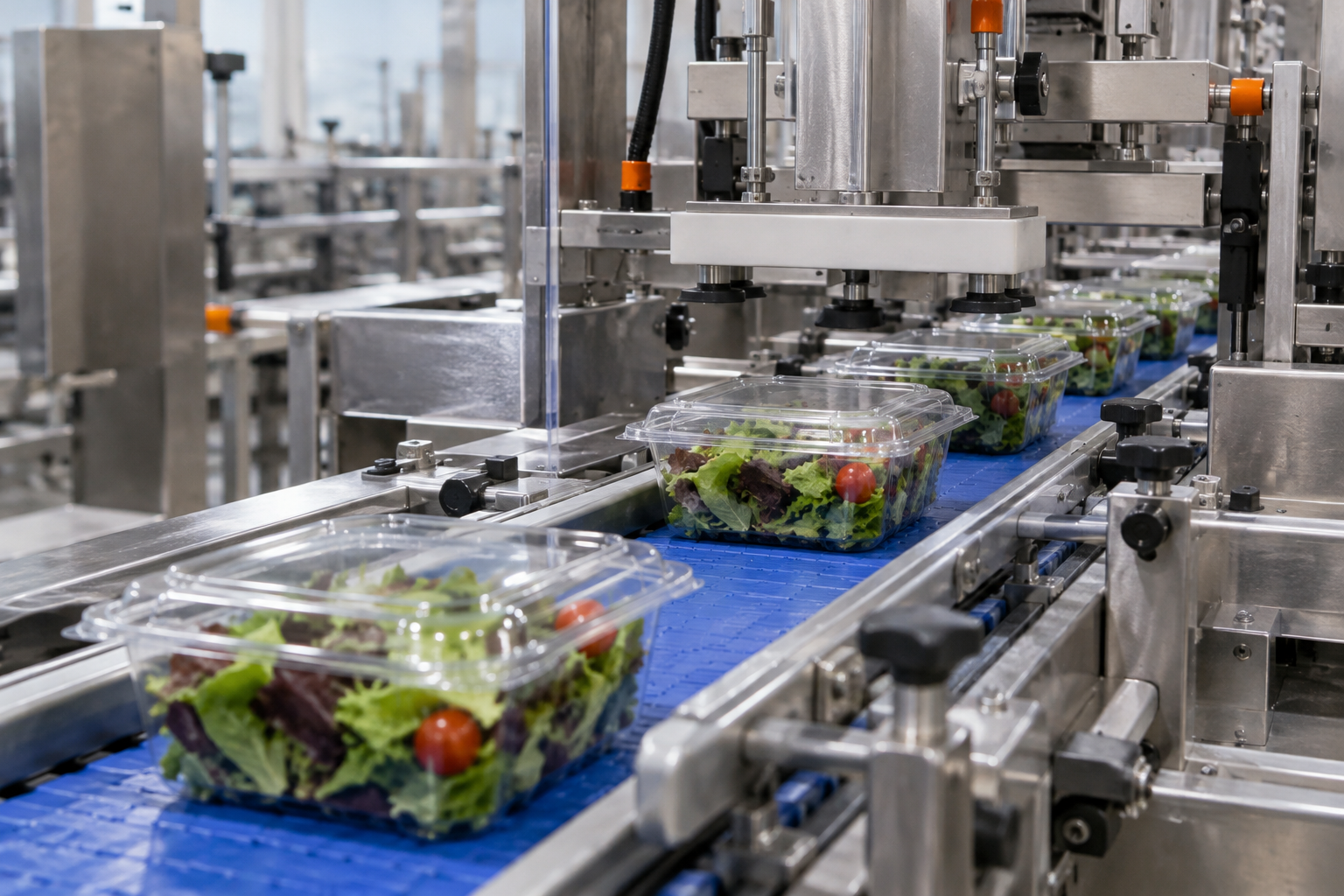
Conveyor speed and spacing determine whether each package reaches the closing area square, supported, and separated from its neighbors. A closer cannot consistently correct containers that arrive touching, sliding, or changing direction. The goal is not simply to run slower. It is to make every arrival predictable.
Understand speed, gap, and pitch
These three measurements are related, but they are not interchangeable:
- Belt speed: How fast the conveying surface travels, usually measured in feet per minute.
- Gap: The clear distance between the back of one container and the front of the next.
- Pitch: The distance from the same point on one container to that point on the next. For identical containers traveling straight, pitch equals container length plus gap.
For evenly spaced containers moving without slip, throughput equals belt speed multiplied by 12, divided by pitch in inches. For example, an 8-inch-long container with a 2-inch gap has a 10-inch pitch. Delivering 60 containers per minute at that pitch requires a belt speed of 50 feet per minute.
That is a conveyor calculation, not a recommended closer setting. Measure the package envelope in its actual running orientation, including any projecting lid or flange that could interfere with another package.
Why faster travel can reduce closing accuracy
Closing takes place over a distance. As the package advances, the lid must come into alignment, approach the rim, and engage the locking features. Increasing travel speed reduces the time available for those actions within a fixed closing section.
Consider a hypothetical 12-inch contact zone. At 40 feet per minute, a container spends 1.5 seconds in that zone. At 60 feet per minute, it spends 1 second. Those figures illustrate contact time only. The required time and pressure depend on the container, tooling, and closing method.
Higher speed can also amplify poor entry conditions. A skewed package reaches the closing guides sooner, leaving less distance for controlled correction. Loose product may shift during acceleration. A flexible lid may bounce rather than settle into position. Adding closing pressure without correcting those conditions can deform the flange instead of improving latch engagement.
Too little spacing creates package-to-package interference
When containers touch, the upstream package can push the one being closed. That changes its position relative to the closing mechanism. With hinged containers, an open lid can also overlap or catch an adjacent package, depending on orientation.
Tight spacing becomes especially troublesome when the downstream conveyor slows or stops. A short backup can turn a properly spaced stream into a compressed queue. Side guides may keep that queue straight, but they do not eliminate forward pressure.
Watch for a recognizable pattern: closing looks acceptable during steady running, then several packages fail immediately after a restart. Check accumulated containers and the release sequence before changing the closing head. I would rather fix an uncontrolled queue than keep tightening guides around it.
More gap is not always better
Extra spacing can prevent interference, but it has a cost. At a fixed belt speed, larger pitch reduces throughput. Maintaining the same output with larger gaps requires faster travel, which may introduce the alignment and contact-time problems you were trying to avoid.
Uneven gaps are another concern. A line averaging 60 containers per minute can still deliver pairs of closely spaced packages followed by long empty stretches. The average count looks fine. The instantaneous arrival pattern does not.
A photoeye also needs a detectable break between packages if the control system uses that break to distinguish containers. Clear plastic, ribs, labels, and open lids can complicate sensing. Confirm sensor operation with the actual package rather than assuming the visible gap produces a clean signal.
Transfers can destroy good spacing
Check every handoff immediately upstream of the closer. A package may leave one belt square and reach the next belt crooked because one corner catches, the support changes abruptly, or the receiving belt pulls unevenly.
A faster receiving conveyor can create separation, but the result depends on friction, package stiffness, product weight, and how long the container spans both belts. It is not automatically a precise metering device.
- Check transfer height and alignment with the equipment stopped and isolated.
- Inspect for worn belts, sticky residue, and damaged transfer components.
- Set side guides to control wandering without pinching the container.
- Observe loaded packages, not just empty samples.
Upstream presentation matters too. A clamshell denester separates nested containers and places them on the line, but spacing can still change during filling, manual handling, and subsequent transfers.
Set the line using packages, not just drive settings
Start with the equipment manufacturer's settings for the container. Our clamshell closing machine handles 8-64 oz tamper-evident hinged containers at up to 80 containers per minute. That maximum rating is not a guarantee that every container and upstream arrangement will run accurately at maximum output.
Use a controlled setup sequence:
- Establish a baseline. Record container style, fill weight, belt speed, pitch, guide positions, and closing settings.
- Check presentation. Confirm that lids, hinges, and flanges are undamaged and product stays clear of the sealing rim and latches.
- Change one variable. Adjust speed or spacing separately, then inspect a counted sample, such as 100 consecutive packages.
- Record defects by location. Separate front-corner misses, side-latch misses, crushed flanges, and trapped product.
- Test recovery. Include normal stops and restarts under approved operating procedures.
For broader conveyor and packaging equipment planning, PackagingMachine.com is another resource. Define the required package presentation at each handoff before selecting individual machines.
Questions and Answers
Can I keep throughput unchanged while increasing the gap?
Only by increasing travel speed or changing the line arrangement. With unchanged container length, a larger gap increases pitch. Calculate the required belt speed, then verify that the closer and transfers can handle it accurately.
Why do lids miss their locks mainly after a restart?
Containers may accumulate, lose their gaps, or accelerate unevenly. Observe the first packages released after the stop and check whether the infeed restores controlled spacing before they reach the closing mechanism.
Should I slow the belt when only one corner stays open?
Not automatically. First check skew, trapped product, flange damage, and uneven guide contact. Slowing down may help identify a speed-sensitive problem, but a repeated miss at the same corner often warrants an alignment or tooling inspection.
Explore the machines
- Clamshell Denester — Separates nested clamshells and places them on the line.
- Clamshell Filling Systems — Accurate weighing and filling of fresh product.
- Clamshell Closing Machine — Closes and locks hinged clamshell lids automatically.
- Clamshell Labeler — Top, bottom and wrap labeling with print-and-apply options.
- End-of-Line Systems — Case packing, case sealing and palletizing.