CLAMSHELL LABELER
Once closed, each clamshell needs branding, pricing and traceability. Our labeling stations apply top, bottom or wrap-around labels with accurate placement at line speed.
Request a Quote →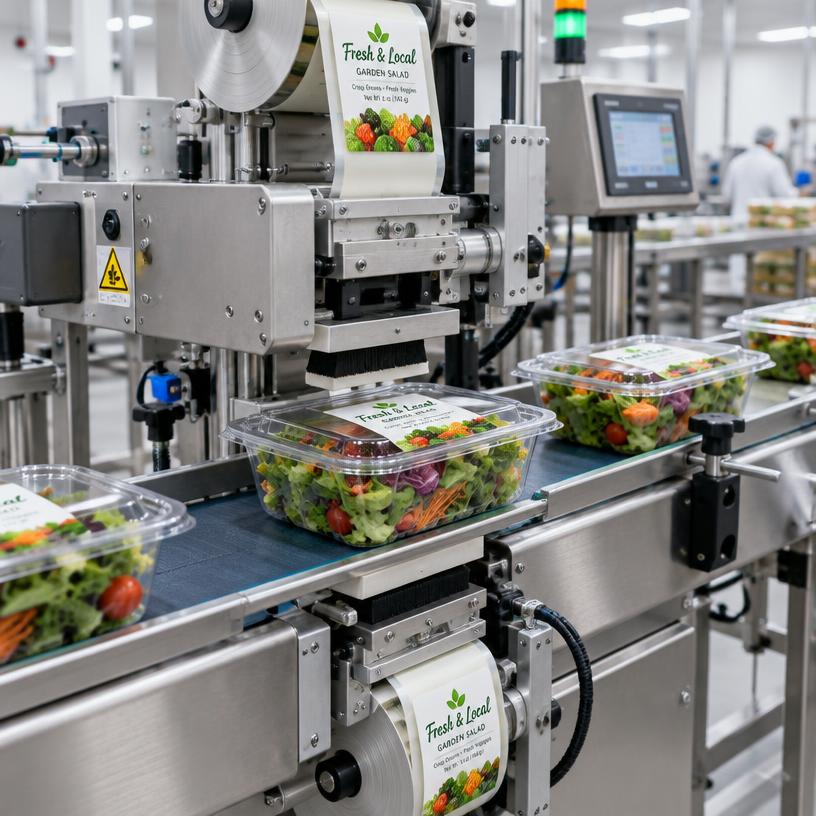
- Speed
- Matched to line
- Positions
- Top / bottom / wrap
- Coding
- Print & apply
- Verification
- Vision optional
Key Features
- Top, bottom and top-and-bottom label application
- Wrap-around and C-wrap options
- Thermal-transfer print-and-apply for dates, lots and PLU codes
- Label presence and barcode verification
- Servo-driven applicator heads
- Quick-release label reels
Traceability built in
Retailers increasingly require lot and date information on every pack. Print-and-apply labelers add variable data in real time, and inline scanners confirm every label is readable.
Label placement
Clamshells have ribs, windows and curved lids. Correct applicator selection keeps labels flat and wrinkle-free on each format.
Where the labeler sits in the line
The labeler runs directly after the clamshell closer. Because the lid is already locked, the top surface is flat and stable, which is what a label applicator needs for consistent placement. Products leaving the labeler move on to checkweighing, case packing and palletizing at the end of the line.
Top labels, bottom labels and wraps
A top label usually carries the brand and product name, while a bottom label carries the weight, price, lot code and barcode. Wrap and C-wrap labels run over the lid and down the sides, which gives more printable area and can also act as a visible seal across the hinge side of the container.
Variable data and print-and-apply
Thermal-transfer printers add pack dates, lot numbers, grower codes and PLU or GTIN barcodes as each clamshell passes. Data can change between runs from the operator screen, so one labeler can handle several customers and SKUs in the same shift without preprinted label stock for each one.
Checking every label
Optional sensors confirm that a label is present on each container, and barcode scanners or vision cameras confirm that the code is readable and correct for the current product. Containers that fail the check can be rejected before they reach a case, which protects retailer compliance.
Changeover between clamshell sizes
Hinged clamshells range from small 8 oz berry packs to 64 oz family packs. Adjustable guide rails, height-adjustable applicator heads and quick-release label reels keep size and label changes short, so the line returns to production quickly.
Frequently Asked Questions.
- Can you label both top and bottom in one pass?
- Yes, with a dual-head labeler positioned above and below the conveyor.
- Can the labeler print dates and lot codes?
- Yes. A thermal-transfer print-and-apply head prints variable data such as pack date, lot number and barcode on each label as it is applied.
- Does the labeler work with the clamshell closer?
- Yes. It is placed right after the closer, so containers arrive with the lid locked and a flat surface for accurate label placement.
- Can it check that each label is correct?
- Optional label-presence sensors and barcode or vision verification confirm each label, and failed containers can be rejected automatically.
Tell Us About Your Line.
Share your product, clamshell style and target speed. We'll map the stages and scope a build.
Request a Consultation