Clamshell Denester: Choosing the Right Denesting System
Sep 28, 2026
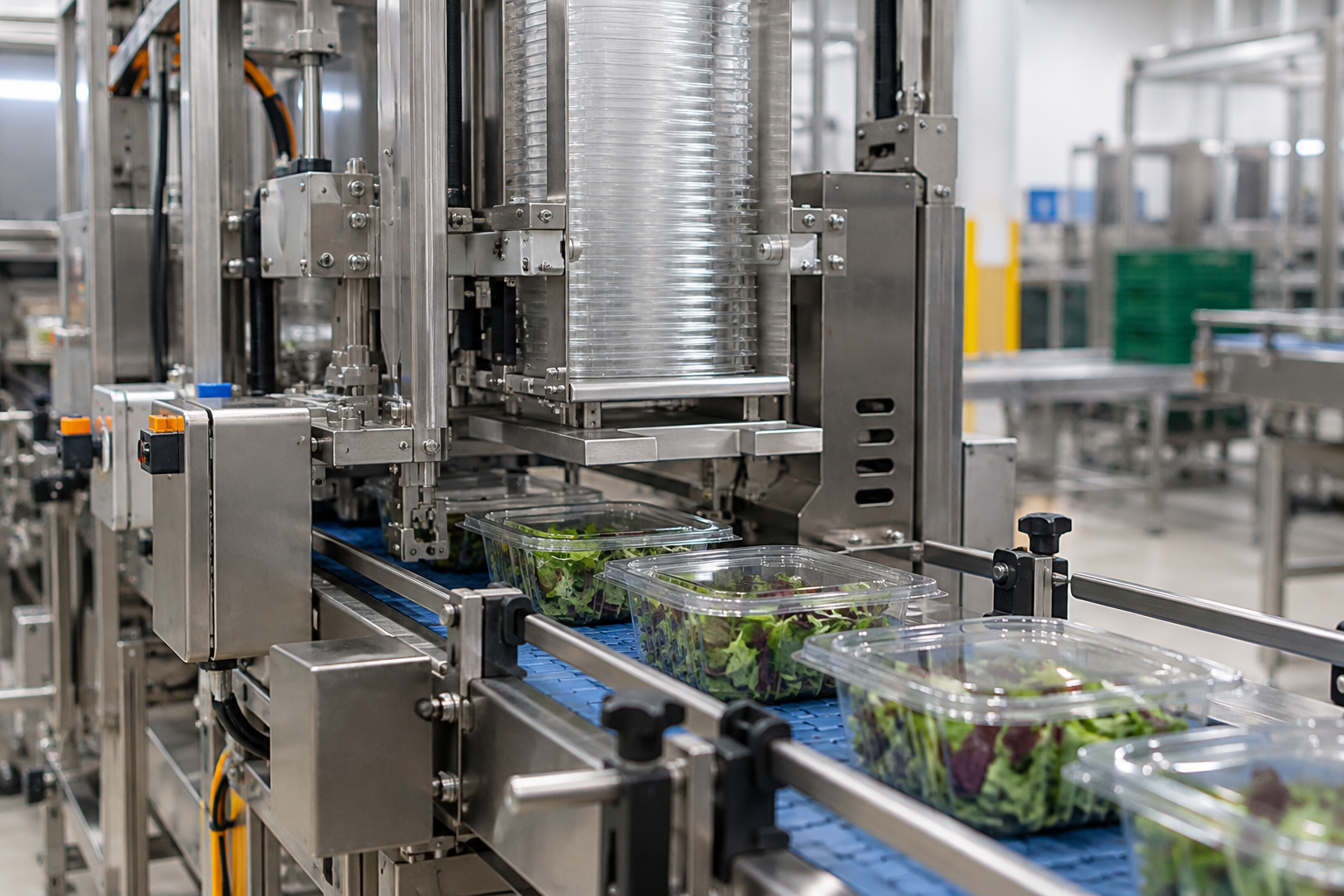
Choose a clamshell denester by testing actual containers, checking stack behavior, matching line demand, and planning for cleaning and changeovers.
Start With the Container, Not the Machine
A clamshell denester has a simple job: separate one container from a nested stack and place it where the next operation needs it. The buying decision is less simple. Two packages with similar outside dimensions can behave differently because of their rim shape, hinge position, stiffness, or nesting depth.
I would start with production samples before discussing machine options. Send the supplier containers from multiple cases and, when possible, different manufacturing lots. Include every size you expect to run. A machine that handles one carefully selected stack has not yet proved it can feed your line all shift.
Define What the Line Actually Needs
Write down your required output in containers per minute, not pounds per hour alone. A line packing 1,200 pounds per hour into 1-pound containers needs 20 containers per minute. Put the same product volume into 8-ounce containers and the requirement becomes 40 containers per minute. That calculation assumes every container reaches its target weight and ignores downtime.
Then identify the real bottleneck. It might be manual product placement, a scale cycle, or the downstream lid-closing operation. Buying more denesting capacity will not fix a filler that routinely waits for product.
- Running rate: The feed rate needed while the line is operating.
- Placement requirement: Container orientation, spacing, and allowable position error.
- Available space: Machine footprint plus room for loading, cleaning, and service.
- Operating schedule: Shift length, package changes, and cleaning frequency.
Separate sustained performance from a brief maximum-rate demonstration. Ask what happens during stack replenishment and after a downstream stop. Those transitions often reveal more than a steady run.
Understand How the Containers Separate
Vacuum Pickup
Vacuum systems use suction cups to grip a container and pull it away from the stack. They can work well when there is an accessible pickup surface that holds a seal. Vents, molded ribs, textured surfaces, and flexible walls can complicate pickup.
Ask where the cups contact the package and whether that surface varies across your container range. Also check cup access. A wear part that takes minutes to reach becomes an expensive nuisance when it needs attention during production.
Mechanical Separation
Mechanical systems use components such as fingers, screws, or escapements to support the stack and release individual containers. Their success depends heavily on rim geometry, nesting clearance, and consistent container dimensions.
Look closely at the released package. Bent rims, stress marks, or damaged latch features are not acceptable trade-offs for feeding speed. Damage at the denester may only become obvious when the lid fails to close farther down the line.
Combined Methods
Some systems combine mechanical separation with vacuum pickup or air assistance. That can help with difficult packages, but more components also mean more settings to document and maintain. Choose the method that repeatedly handles your containers, not the one with the most features.
Test the Packaging Variation You Actually Receive
Nested containers can cling because of friction, static, or trapped air. Stack pressure and storage conditions can change separation behavior. Thin walls can flex during extraction, while slightly distorted rims may catch on neighboring containers.
A useful trial includes full stacks, nearly empty stacks, and containers taken from ordinary shipping cases. Do not let the trial consist entirely of hand-separated packages restacked just before testing. That preparation can hide the sticking you need the machine to overcome.
For a berry operation, test the actual vented package. For bakery production, test the actual hinged container, including its lid position during feeding. Similar capacity does not mean similar denesting behavior.
Record missed picks, double feeds, package damage, and operator interventions. Define each event before the trial so both parties count failures the same way. Keep the test duration and total container count in the report.
Make Stack Loading Part of the Evaluation
Magazine capacity affects how often an operator must return to the machine. At 40 containers per minute, a usable magazine holding 200 containers provides five minutes of theoretical supply. Actual unattended time will be shorter if operators must reload before the stack runs out.
Watch someone replenish the magazine. Can they load it without reaching over moving equipment? Can a stack go in backward? Does loading disturb the containers already feeding? If replenishment requires stopping, include that lost time in the output calculation.
Check working height and access with your plant team. A compact machine is not useful if its magazine faces a wall or blocks the aisle used to bring in packaging.
Match the Discharge to the Next Operation
The denester must deliver more than a separated container. It must deliver a usable container in the correct position. An open lid can interfere with guides, sensors, or neighboring packages if its orientation is not controlled.
When evaluating a clamshell denester, specify the receiving conveyor height in inches, belt direction, package spacing, and required hinge orientation. Establish which controls stop feeding when the downstream conveyor backs up.
If the next station uses automated weighing, discuss the handoff with the supplier of your clamshell filling system. The package may need to stop under a discharge point rather than move continuously. Agree on container-present signals and fault recovery before installation.
Check Changeovers, Cleaning, and Maintenance
Ask the supplier to demonstrate a changeover between your smallest and largest packages. Time the complete process, including adjustments, trial containers, and confirmation of stable feeding. A stored recipe does not eliminate the need to move guides or replace tooling.
For food production, match the machine to your actual sanitation procedure. Stainless steel construction alone does not establish washdown suitability. Confirm cleaning methods, electrical protection, drainage, and access to areas where debris can collect.
- Request a list of format-specific parts and their prices.
- Identify routine wear items and recommended onsite spares.
- Check access to cups, sensors, guides, and separation tooling.
- Require documented energy-isolation procedures for servicing and jam clearing.
Buy Against Written Acceptance Criteria
Put the agreed package list, sustained feed requirement, placement tolerance, and allowable fault counts into the purchase specification. State the trial duration, loading method, and conditions for retesting after adjustments.
For broader line planning, discuss conveyor handoffs and control responsibilities with a packaging equipment resource such as Packaging Machine. One supplier should not assume another is handling the interface.
The right purchase is the denester that meets those conditions with ordinary production packaging and manageable operator attention. Price matters, but repeated interruptions can quickly outweigh a lower initial quote.
Questions and Answers
Can one denester handle vented berry packs and bakery clamshells?
Possibly, but both formats need testing. Pickup surfaces, rim geometry, hinge position, and package stiffness may require different tooling or adjustments.
How should double feeds be evaluated during a trial?
Count every double feed and record whether the machine detects it, stops, or passes it downstream. Include the operator time required to recover.
Should a container supplier change trigger another denesting test?
Yes. Similar-looking containers can have different nesting clearance or stiffness. Test samples before approving the change for production.
Explore the machines
- Clamshell Denester — Separates nested clamshells and places them on the line.
- Clamshell Filling Systems — Accurate weighing and filling of fresh product.
- Clamshell Closing Machine — Closes and locks hinged clamshell lids automatically.
- Clamshell Labeler — Top, bottom and wrap labeling with print-and-apply options.
- End-of-Line Systems — Case packing, case sealing and palletizing.