Checkweighing Clamshells: Where It Fits and What It Catches
Oct 22, 2026
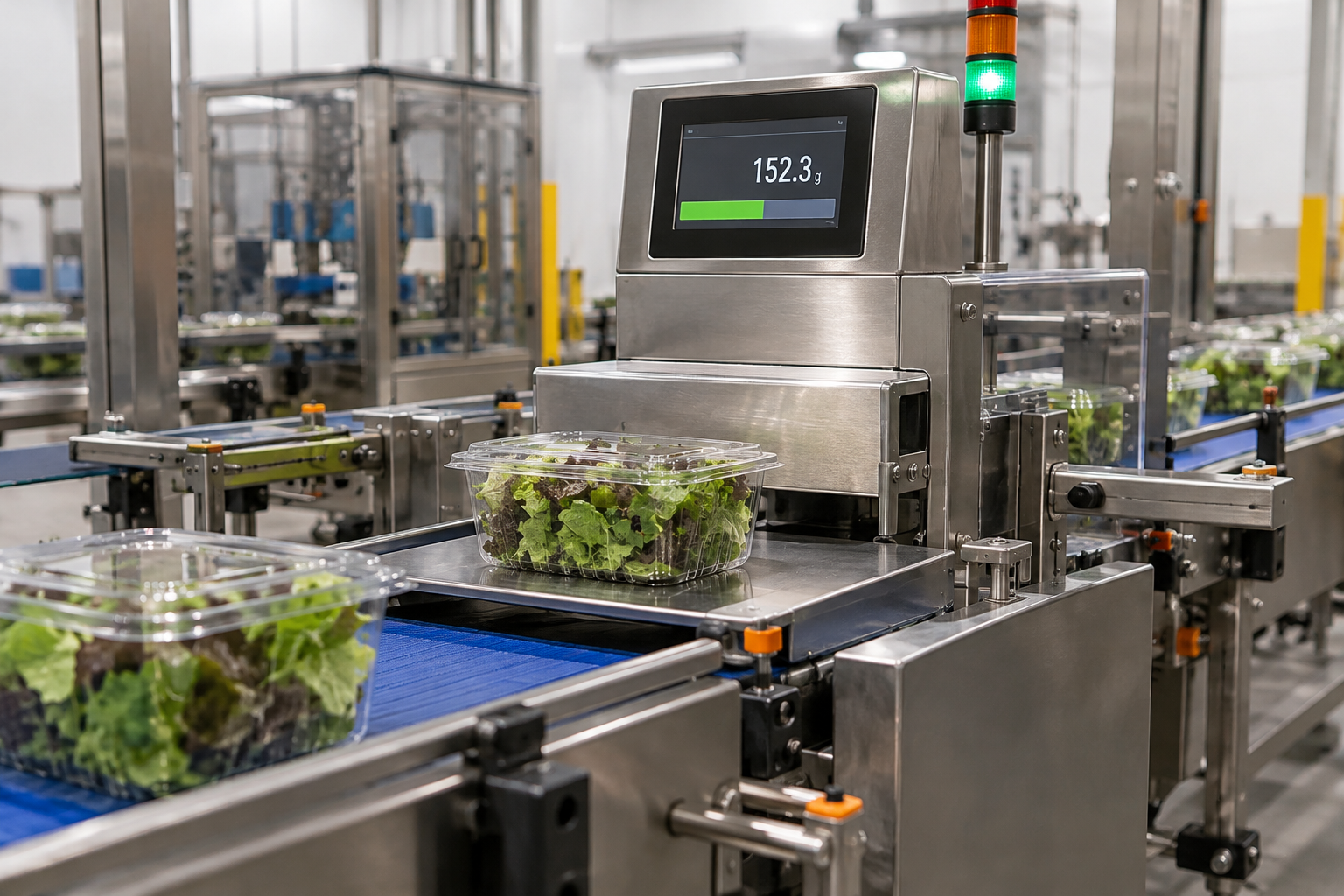
Learn where to place a clamshell checkweigher, what weight checks can catch, and how to manage tare, rejects, and filler feedback.
A weight check is a process checkpoint
A clamshell can look full and still be light. Large berries leave air spaces. Bakery pieces vary in weight. A leaf caught on the rim may look like a small housekeeping problem until it prevents the lid from locking.
A checkweigher answers one narrow question: does this package weigh within the limits assigned to this product? It does not count berries, inspect every latch, or confirm freshness. Its value comes from putting that measurement in the right place and giving rejected packages somewhere controlled to go.
I treat checkweighing as a checkpoint, not a repair station. It identifies variation. The filler, operator, or upstream process has to correct the cause.
Where the checkweigher belongs
For most retail clamshell lines, the useful location is after filling and closing, before case packing. At that point, the machine checks the individual package that will enter a shipping case. An underweight package can be removed without opening a case downstream.
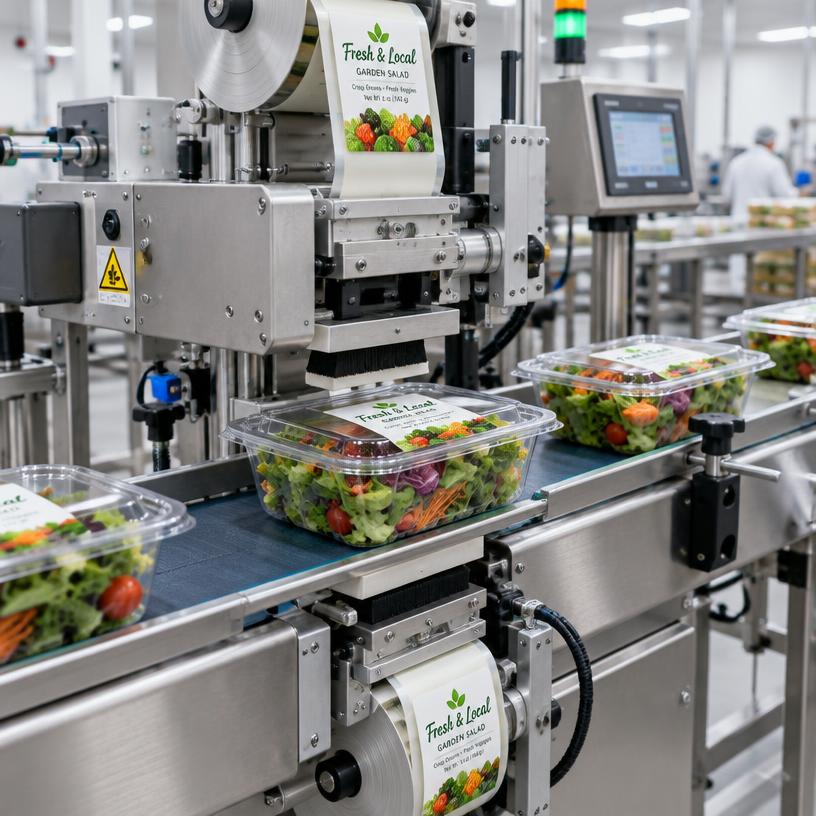
Label placement requires a decision. Weighing after labeling includes the label in the package tare and checks a more complete retail unit. Weighing before labeling avoids applying labels to weight rejects. Either arrangement can work, but the tare setting must match what actually crosses the scale.
A practical sequence is denest, fill, close, checkweigh, label, and case pack. If labels are applied before weighing, establish the tare with the label attached. Do not use a tare value from an empty, unlabeled container and assume the difference will disappear in rounding.
Keep the checkweigher away from conveyor impacts and unstable transfers. A closing station can introduce vibration or irregular package spacing if the equipment is poorly integrated. Our Clamshell Closing Machine handles 8-64 oz tamper-evident hinged containers at up to 80 containers per minute. The checkweigher and its reject system must support the actual package dimensions and operating rate, not just a catalog throughput figure.
Gross weight is not declared net weight
The scale measures everything riding across it: product, container, label, pad, and any other packaging components. The declared net quantity refers to the contents, excluding packaging. Most checkweighing applications estimate net weight by subtracting an assigned tare from measured gross weight.
Consider a hypothetical 16 oz berry pack with a 0.8 oz container-and-label tare. A gross reading of 16.8 oz corresponds to an estimated 16 oz of berries. If the actual tare is 0.9 oz, that same reading represents only 15.9 oz of berries. The display can look acceptable while the assumption behind it is wrong.
Measure tare across a representative sample, including different container lots when appropriate. Include absorbent pads and inserts. Establish how tare changes will be checked at changeovers and replenishment.
Do not confuse a production reject limit with legal compliance. U.S. net-content requirements generally address both lot averages and limits on individual shortages under applicable rules. Setting a reject threshold at one convenient number does not establish compliance. Review the applicable requirements and sampling procedures for your product and jurisdiction.
What weight checks can catch
- Short fills: An interrupted feed, bridging product, or incomplete discharge can produce a light package.
- Excess product: Overfills increase giveaway and may interfere with closing or case fit.
- Large component omissions: A missing muffin or other substantial item may create a detectable weight difference.
- Gross packing errors: An empty clamshell or an extra container carried through the line may fall outside the accepted range.
- Process drift: A rising or falling average can reveal a developing filling problem before rejects become frequent.
Those are detection opportunities, not guarantees. A missing bakery piece can be hidden by heavier remaining pieces. An extra container can be masked by a short fill. Detection depends on the defect's weight difference relative to normal product variation, tare variation, measurement uncertainty, and the acceptance limits.
A clamshell with an open latch may weigh exactly what it should. So can a package with the wrong label, a crushed strawberry, or a foreign object that adds very little weight. Use closure inspection, label verification, and appropriate contamination controls for those risks.
Give the scale a fair measurement
Dynamic weighing requires a stable, isolated measurement. Packages must travel through with sufficient spacing and without touching each other. During the weighing interval, the clamshell must be fully supported by the weighing conveyor, without contact with adjacent belts or side guides.
A long container needs enough weighing-belt length and time to settle and measure. A broad hinged lid can drag on a guide even when the base appears centered. Lightweight packs are especially sensitive to vibration, drafts, and abrupt belt-speed changes.
Run trials with real product and production containers. Empty-container demonstrations do not reproduce berries shifting inside a pack or bakery products sliding during acceleration. Ask the supplier to demonstrate performance across your expected weight range, package sizes, and line rates. For broader line integration discussions, PackagingMachine.com is another equipment resource.
Make rejection a controlled operation
A correct measurement is useless if the wrong package gets pushed off the belt. Reject timing must follow the package from the scale to the reject point, including changes in conveyor speed and spacing.
Choose a reject method that suits the package. An aggressive side push can open a poorly latched lid or scatter berries. Provide a controlled collection area, reject confirmation where appropriate, and a defined response to a full reject bin or failed rejection.
At startup, changeover, and scheduled intervals, challenge the system with identified test packages of known weight. Verify measurement, classification, physical rejection, and alarms. Keep challenge packages out of saleable production.
Use the data to reduce giveaway
Track average weight, weight variation, reject counts, and tare changes by product and shift. If the average is high but variation is narrow, the fill target may need adjustment. If weights swing widely, lowering the target will likely create more short fills.
Investigate feed consistency and discharge behavior first. Properly configured Clamshell Filling Systems address weighing and filling upstream. Checkweigher feedback, whether manual or automatic, should use validated rules rather than chase every individual package.
Questions and Answers
Should absorbent pads be included in clamshell tare?
Yes. Include every packaging component present at the weighing point. Check pad weight variation when establishing the tare procedure.
Can a checkweigher prove that all six muffins are present?
Not by weight alone. Natural muffin-weight variation can hide a missing piece. Use counting or vision inspection when piece count must be verified independently.
What should happen to a light berry clamshell after rejection?
Move it into a controlled rework process. Correct the fill, inspect the closure, and recheck its weight before release. Never return it to the accepted stream without verification.
Explore the machines
- Clamshell Denester — Separates nested clamshells and places them on the line.
- Clamshell Filling Systems — Accurate weighing and filling of fresh product.
- Clamshell Closing Machine — Closes and locks hinged clamshell lids automatically.
- Clamshell Labeler — Top, bottom and wrap labeling with print-and-apply options.
- End-of-Line Systems — Case packing, case sealing and palletizing.