Case Packing Clamshells: Manual Stations vs Automatic Erectors
Sep 23, 2026
Compare manual case packing with automatic case erectors by labor, throughput, carton quality, floor space, and clamshell protection.
A clamshell line can run well until someone has to open a corrugated case, fold the bottom flaps, tape it, load containers, and push it toward shipping. That station becomes the bottleneck. But buying an automatic case erector does not automatically solve a case-packing problem.
The first question is where time is actually going. Making boxes, loading clamshells, and sealing loaded cases are three separate jobs. Measure them separately before deciding which one needs equipment.
A case erector makes boxes. It does not pack them.
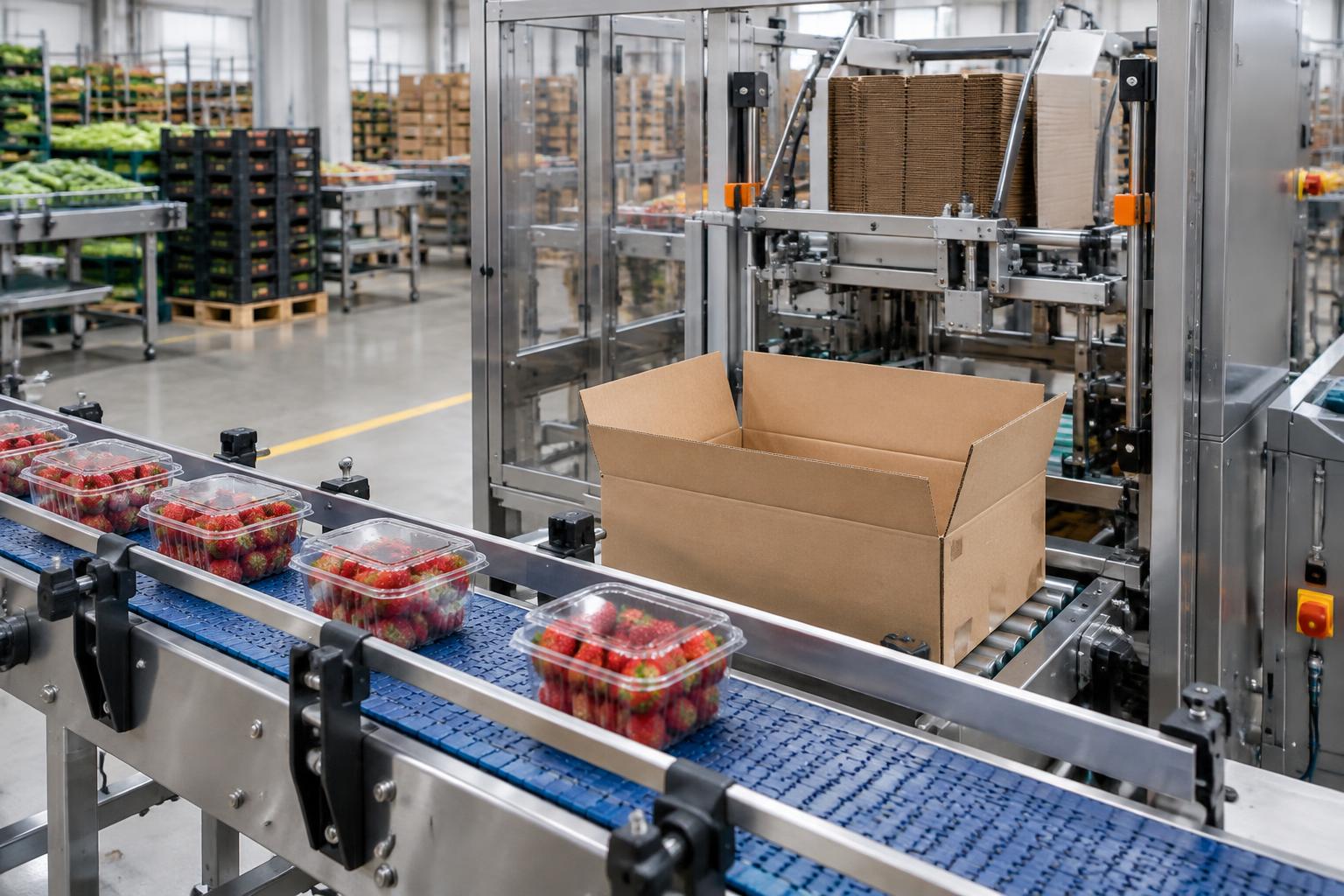
An automatic case erector takes flat corrugated blanks from a magazine, opens them, folds the bottom flaps, and seals the bottom, typically with tape or hot-melt adhesive. It then presents an empty case for loading.
A case packer loads the product. A case sealer closes and seals the loaded case. Those functions can be connected, but they are not interchangeable.
For many produce and bakery operations, the useful comparison is not fully manual versus fully automatic. It is a manual station where operators make and load boxes versus a station where an erector supplies boxes and operators still load clamshells. That middle arrangement deserves serious consideration.
Convert container output into case demand
Start with the actual sustained output reaching the packing station, not the highest number printed on an upstream machine's specification sheet.
The clamshell closing machine handles 8-64 oz tamper-evident hinged containers at up to 80 containers per minute. If a particular line actually delivers 80 containers per minute, the packing demand changes with the case count:
- 12 containers per case: about 6.7 cases per minute, or one case every 9 seconds.
- 8 containers per case: 10 cases per minute, or one case every 6 seconds.
- 6 containers per case: about 13.3 cases per minute, or one case every 4.5 seconds.
These are calculated case requirements, not equipment performance claims. They also assume continuous output with no rejects or interruptions.
Now time the work. If an operator needs 7 seconds just to form and bottom-tape a case, a six-count pack at that output cannot be supported by that person alone, even before loading begins. I would do this arithmetic before requesting a quote.
Where manual stations make sense
Manual case preparation is reasonable when volumes are modest, runs are short, or case styles change frequently. It also allows operators to handle unusual pack patterns, inserts, and mixed-product orders without extensive machine adjustments.
The station still needs engineering. Put blanks within easy reach. Support the case at a comfortable loading height. Position incoming clamshells so operators do not repeatedly twist while carrying product. Keep finished cases from backing up into the loading area.
Measure the whole task
During a representative production run, record time spent retrieving blanks, forming and taping cases, loading containers, adding pads, closing top flaps, and moving finished cases. Include replenishment and minor delays.
Do not use the fastest observed cycle as the staffing standard. A station must work through a full shift, including different operators and normal material variation.
Manual stations become less attractive when people constantly build boxes ahead of production, empty cartons occupy aisles, or packers abandon loading to replenish supplies. Those are signs that case preparation is consuming capacity needed elsewhere.
What an automatic erector changes
An erector separates box preparation from product loading. Packers receive formed cases instead of alternating between corrugated handling and delicate product handling. That can make the loading rhythm more consistent.
It does not eliminate all labor. Someone must load the blank magazine, replenish tape or adhesive, perform changeovers, and respond to faults. Maintenance and sanitation access also take floor space.
Specify the erector against the actual case range and construction. Minimum and maximum dimensions alone are not enough. Blank quality, score locations, flap geometry, board condition, and the manufacturer's joint can affect opening and squaring.
Ask for trials using your production blanks, not just a supplier's demonstration carton. Include material stored under your normal operating conditions. Corrugated exposed to moisture or damaged during storage may behave differently from fresh, dry samples.
Protect clamshells during loading
A square case is useful, but it cannot compensate for a poor pack pattern. Clamshells need enough clearance to enter without catching hinges, closure tabs, or labels. Excess space can allow movement during distribution.
Check the loaded case with actual product. Berry packs and decorated bakery items present different damage risks, even when their outside container dimensions are similar.
- Confirm that lids remain locked after loading.
- Look for bowed sidewalls, crushed corners, and label scuffing.
- Verify layer pads and container orientation against the approved pack pattern.
- Inspect bottom seals and loaded-case handling through the downstream conveyor.
If product loading is already the slowest task, an erector alone will not increase output. Additional loading positions, a better presentation conveyor, or an automatic case packer may be the next step.
Compare cost per good case
Use a simple labor calculation first. Suppose a station consumes 24 labor-hours per shift and ships 3,000 acceptable cases. That is 0.008 labor-hour per case. At an assumed fully burdened labor cost of $25 per hour, direct station labor is $0.20 per case.
If a proposed arrangement genuinely reduces staffing by 8 labor-hours, the calculated saving is $200 per shift. That is an illustration, not a promised result. Verify whether the operator can actually leave the station or merely spends less time making boxes.
Then include installed equipment cost, utilities, consumables, maintenance, training, changeover time, and expected downtime. Count damage and rework too. Compare alternatives at the same shipment volume and product mix.
Buy the next useful step
Keep manual preparation when it reliably meets demand without excessive handling. Add an erector when box making is the measured constraint and the case range suits automation. Consider automatic loading when placing clamshells is the remaining bottleneck.
Review the handoffs as part of an end-of-line system, including case sealing and palletizing. For broader equipment discussions, PackagingMachine.com is another relevant resource. Bring case drawings, samples, pack patterns, and observed cycle times to the conversation. The right purchase removes a measured constraint, not just a visible manual task.
Explore the machines
- Clamshell Denester — Separates nested clamshells and places them on the line.
- Clamshell Filling Systems — Accurate weighing and filling of fresh product.
- Clamshell Closer — Closes and locks hinged clamshell lids automatically.
- Clamshell Labeler — Top, bottom and wrap labeling with print-and-apply options.
- End-of-Line Systems — Case packing, case sealing and palletizing.