Berry Packaging Machines: Blueberry to Blackberry Lines
Oct 4, 2026
Plan a berry packaging line around gentle filling, reliable clamshell handling, accurate weights, and dependable closing for three different fruits.
Start With the Fruit, Not the Machine Speed
A berry packaging machine has to do more than put fruit into plastic. It must separate empty clamshells, deliver the right weight, protect the berries, close the package, and send it downstream without creating a traffic jam. Blueberries, raspberries, and blackberries put different demands on every step.
My first question is not how fast the equipment runs. It is what condition the fruit is in when it reaches the hopper. Firm, chilled blueberries behave differently from soft raspberries nearing the end of their usable packing window. An equipment trial that ignores that difference tells you very little.
Three Berries, Three Handling Problems
Blueberries: Control Rolling and Product Flow
Blueberries generally tolerate automated handling better than raspberries, but they roll, bounce, and escape through poorly designed transfers. Belt gaps, side-rail openings, and abrupt discharge points deserve close attention. Bruising may not be obvious immediately, so an attractive pack at discharge is not enough evidence of gentle handling.
Keep the feed depth consistent. A surge of fruit can overwhelm a weighing cycle, while a nearly empty feed belt starves it. Use controlled feeding rather than asking operators to compensate by repeatedly dumping larger quantities into the hopper.
Raspberries: Minimize Pressure and Repeated Transfers
Raspberries are hollow and easily compressed. Deep product beds, aggressive vibration, and repeated drops can damage them before they ever reach the package. Short, supported transfers and shallow accumulation are worth more than a high advertised rate.
Watch how fruit leaves each surface. A nominal 2-inch drop can still be damaging if berries land on a hard edge or strike fruit already in the container. Test the complete path, not just the final filling chute.
Blackberries: Account for Size Variation
Blackberries vary substantially in size and firmness. Large berries can bridge at narrow openings, and a few oversized pieces can make small-package weights harder to control. Their uneven shape also affects how they settle.
A package can meet its weight target and still have fruit sitting above the rim. That becomes a closing problem. Confirm fill distribution and headspace with the actual berry size range expected during the season.
Build the Line Around Stable Container Handling
Automation usually starts with denesting. Empty clamshells must separate consistently and arrive open, correctly oriented, and properly spaced. Thin walls, static, warped stacks, and variations between container lots can all cause trouble.
Run samples from more than one production lot. Check hinge behavior, flange shape, and nesting depth. A denester adjusted around one unusually cooperative stack may struggle when the next shipment arrives.
Container control matters after denesting, too. Guides should locate the base without squeezing it out of shape. Open lids need support so they do not swing into the filling area. Before buying equipment, confirm who supplies the container tooling and how operators change it.
Choose Filling Equipment by Damage and Weight Performance
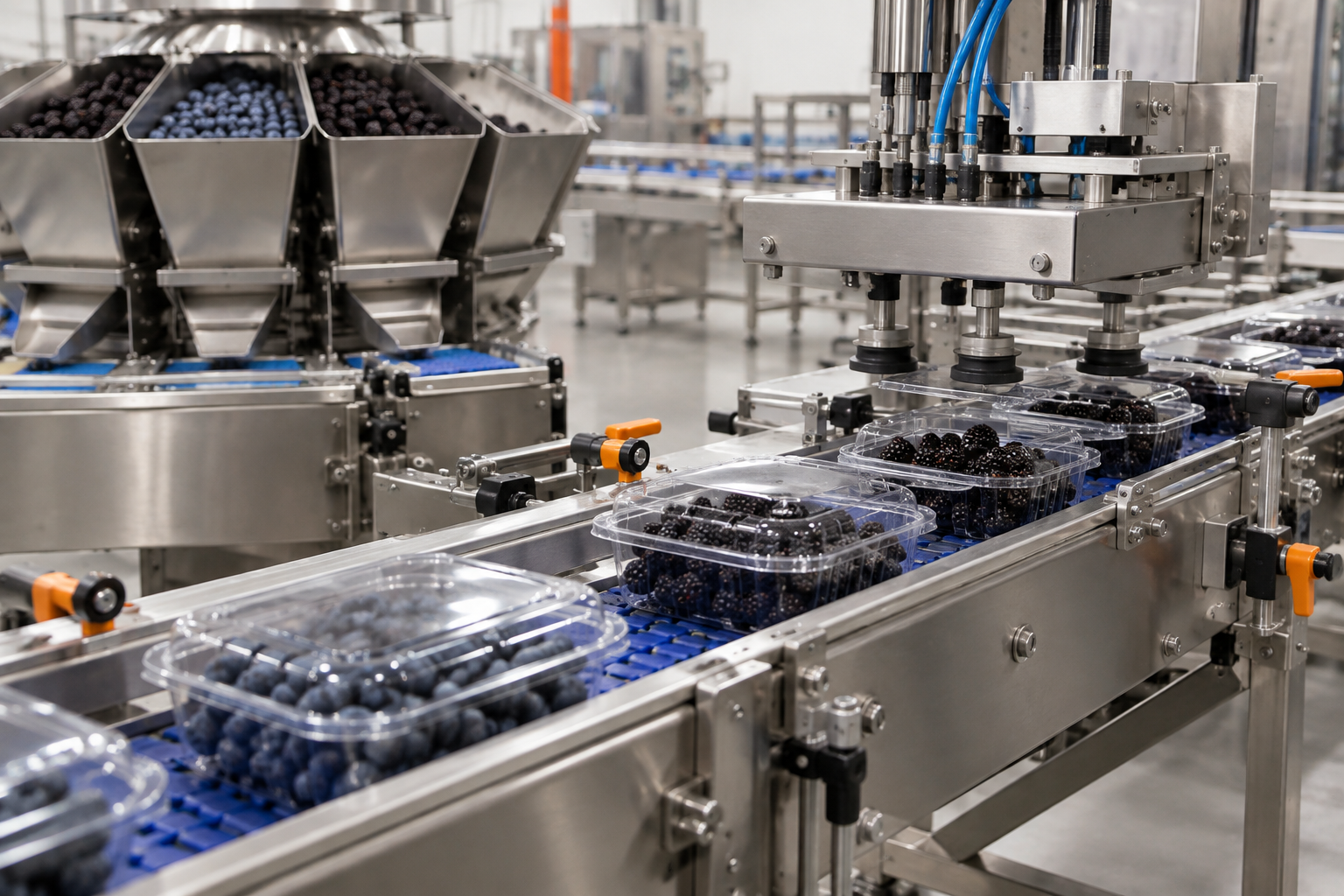
The right clamshell filling system must balance accurate weighing with gentle product delivery. Ask how fruit is metered, how many transfers occur, and what happens when a package is missing. Product should not discharge into an empty conveyor position.
Evaluate the filler using three measurements together:
- Net-weight performance: Record individual package weights, not just the average.
- Fruit condition: Compare damage before filling, immediately afterward, and after a representative storage period.
- Accepted output: Count saleable packs after closing and inspection, not filler cycles alone.
Giveaway adds up quickly. As an illustration, an average excess of 0.1 ounce across 20,000 packages equals 125 pounds of fruit. But reducing the target without checking weight variation can increase underweight packages. Set targets around demonstrated process capability and applicable net-content requirements.
Keep Fruit Out of the Closing Area
Closing failures often begin upstream. A berry on the flange, an uneven fill, or a distorted container can prevent the lid from locking. More closing force is not the first fix. It may crush fruit or damage the package while leaving the underlying problem untouched.
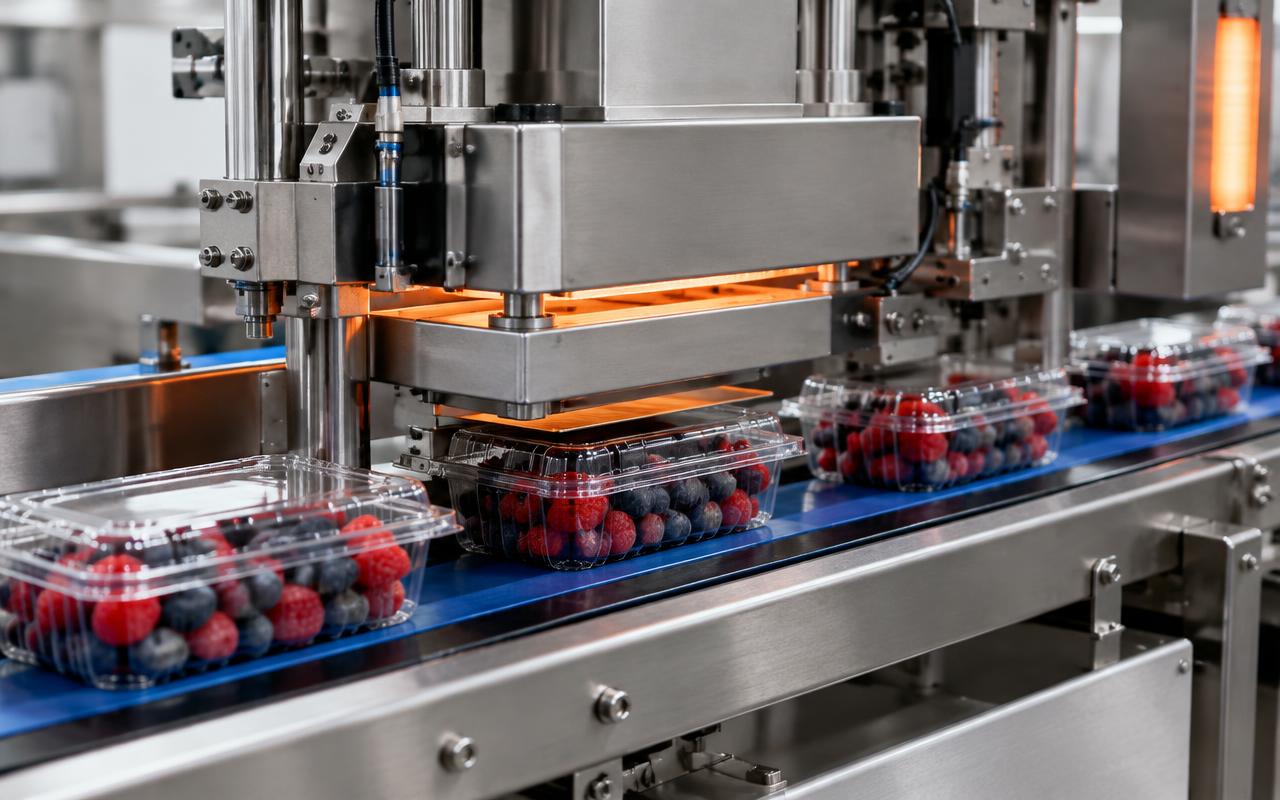
Our Clamshell Closing Machine handles 8-64 oz tamper-evident hinged containers at up to 80 containers per minute. Confirm compatibility with the exact container and lid-lock design. Package size alone does not establish fit, and actual line output depends on filling, container presentation, and downstream capacity.
Inspect the entire closure, including corners and tamper-evident features. A lid that looks flat is not necessarily locked. Build routine closure checks into startup, container-lot changes, and restart procedures.
Match Labeling and Case Packing to the Filler
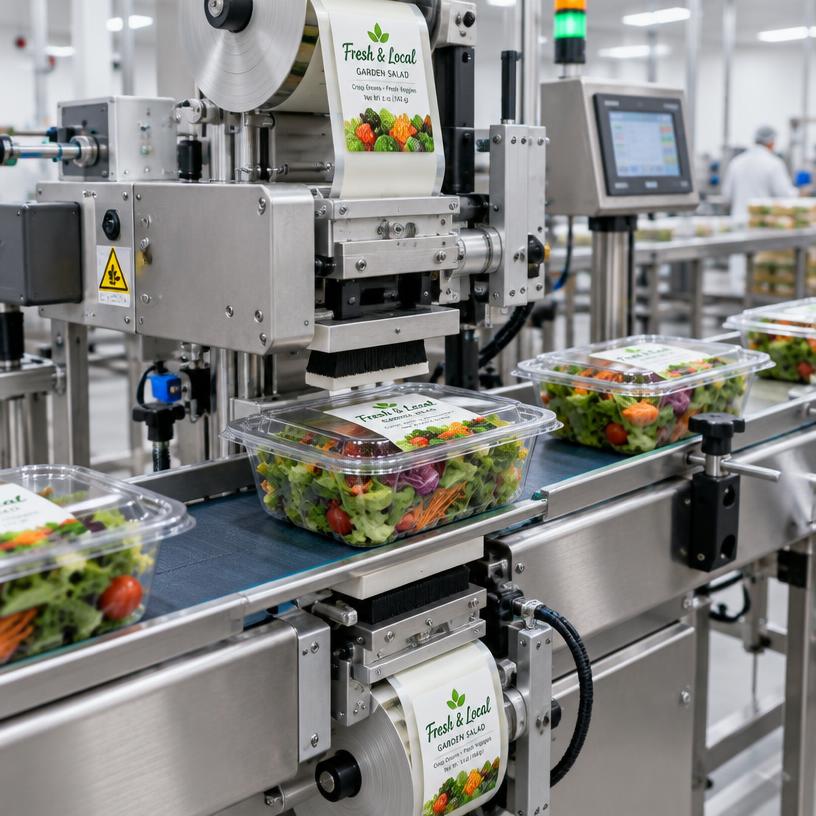
Cold containers can collect condensation when exposed to warmer, humid air. That affects label adhesion. Trial the label stock and adhesive under actual packing and storage conditions, including the time between filling and labeling.
Keep labels clear of vents and closure features unless the package design specifically calls for that placement. Verify date and lot-code readability after handling, not only at the printer.
Case packing also sets the practical line rate. For example, 60 packages per minute in 12-count cases requires five completed cases per minute. Include case erection, sealing, and pallet removal in that calculation. For broader equipment planning, PackagingMachine.com is another resource to review alongside the berry-line layout.
Make the Acceptance Trial Look Like Production
A useful trial includes soft fruit, normal container variation, planned stops, and a product changeover. Do not accept a demonstration based only on a few uninterrupted minutes with carefully selected berries.
- Run each berry and container combination included in the purchase scope.
- Record stoppage causes and the time required to clear them.
- Check access for removing trapped berries and cleaning product-contact surfaces.
- Measure changeover time through the first acceptable package.
- Confirm that downstream backups stop upstream feeding without crushing accumulated packs.
The best line is the one the crew can keep clean, adjusted, and supplied through a full shift. That is a more useful buying standard than peak speed alone.
Questions and Answers
Can one berry filling line handle blueberries, raspberries, and blackberries?
Yes, if its feeding and transfer arrangements suit all three. Expect different settings and possibly different tooling. Prove raspberry handling and large-blackberry clearance during trials rather than assuming a blueberry demonstration covers them.
Why do correctly weighed berry packs fail to close?
Weight does not guarantee adequate headspace. Large berries, uneven distribution, fruit on the flange, or container distortion can obstruct the lid. Check presentation before increasing closing force.
How should we verify raspberry damage during a machine trial?
Compare matched samples before and after machine handling. Look for crushed berries, juice leakage, and deterioration after representative cold storage. Use the same sampling method and storage conditions for both groups.
Explore the machines
- Clamshell Denester — Separates nested clamshells and places them on the line.
- Clamshell Filling Systems — Accurate weighing and filling of fresh product.
- Clamshell Closing Machine — Closes and locks hinged clamshell lids automatically.
- Clamshell Labeler — Top, bottom and wrap labeling with print-and-apply options.
- End-of-Line Systems — Case packing, case sealing and palletizing.