Bakery Clamshell Packaging: Cookies, Muffins and Pastries
Oct 13, 2026
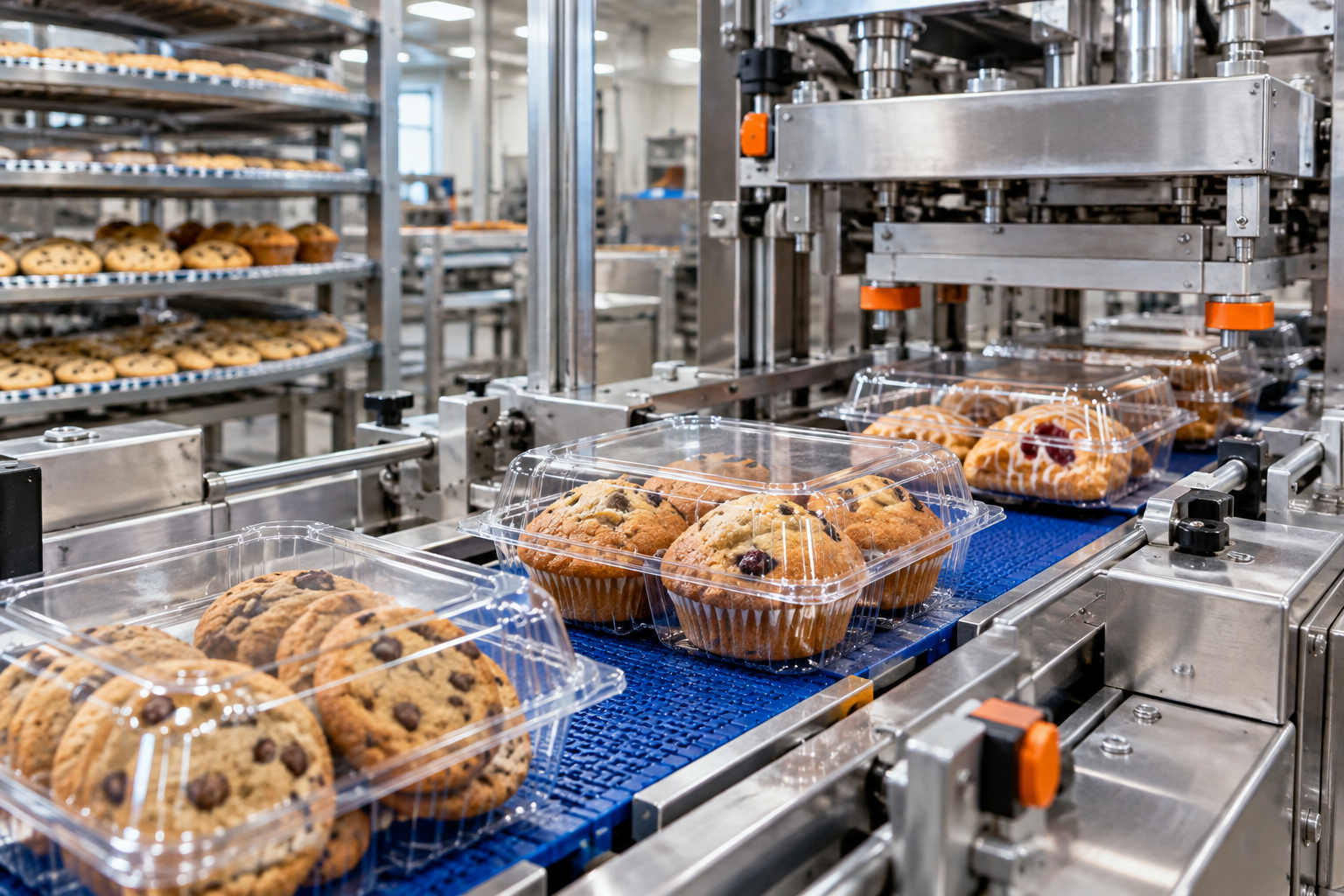
Plan bakery clamshell automation around product cooling, gentle loading, reliable lid closure and practical changeovers for cookies, muffins and pastries.
Bakery clamshell automation usually gets difficult before the lid closes. Cookies overlap. Muffin crowns extend beyond their pockets. An iced pastry looks fine entering the conveyor, then picks up a clear streak where the lid touches it. A faster closer cannot fix those problems.
The right line starts with the product, the container and the condition of both at packaging. Then you work through denesting, loading, closing, labeling and case packing. I would rather find a clearance problem with 20 samples on a bench than with 20,000 containers on the production floor.
Start with the product at packaging temperature
Cookies, muffins and pastries need different handling even when their packages have similar footprints. Write down the product dimensions, weight range, surface condition and acceptable orientation. Measure actual production, including the largest pieces, rather than relying only on the recipe specification.
- Cookies: Define the count, stack height and allowable breakage. Thin cookies may chip at transfers; soft cookies may bend or stick together.
- Muffins: Check crown diameter, total height and liner position. A liner caught across the container rim can interfere with closure.
- Pastries: Identify icing, glaze, loose toppings and fragile layers. These determine where a gripper or guide can safely touch the product.
Cooling deserves its own check. Packaging warm baked goods can produce condensation as moisture collects on cooler surfaces. It can also affect texture and label adhesion. There is no single packaging temperature that works for every recipe and package. Establish a release condition through product trials and shelf-life testing, with your food safety team involved where fillings require temperature control.
Choose the clamshell before specifying the line
A container that works at a packing table may behave differently under automatic handling. Operators compensate for warped rims, tight nesting and inconsistent hinges without much thought. Machinery needs those variations brought within an agreed operating range.
Test containers from multiple manufacturing lots. Check nesting depth, hinge resistance, latch engagement and the rigidity of the base. Confirm that the lid clears the tallest product after closing, not just while someone holds it above the package.
For example, a muffin measuring 3 inches tall inside a package with 3 inches of nominal height has no demonstrated clearance. Internal ribs, the base pocket and dimensional variation all matter. Measure the usable space with the actual muffin seated in position.
Tamper-evident features also need testing. The package must close without prematurely damaging the feature, and opening it must produce the intended visible evidence. Do not assume every hinged bakery container is tamper-evident.
Automate denesting without creating a loading problem
A clamshell denester separates nested containers and places them on the line. Its value depends on consistent presentation: the base must arrive in the correct position, with the open lid controlled so it does not obstruct loading.
Include double-pick detection and missing-container handling in the equipment discussion. Product should not discharge onto an empty conveyor position. Ask how the machine responds when a stack runs low, and whether replenishment requires stopping production.
Loading often remains the limiting step. Consider a six-count muffin pack at a planning target of 30 packages per minute. That requires 180 muffins per minute to be presented, oriented and placed. This is a demand calculation, not an equipment rating. It quickly shows whether manual loading, assisted placement or automatic handling deserves a closer look.
For cookies, count and arrangement may matter more than total weight. For pastries, trays or supported transfers may protect the product better than repeated individual handling. Test the complete movement, including starts and stops.
Close the lid without crushing the saleable product
The closing station needs a stable base, a controlled lid path and a clear rim. Crumbs, paper liners and misplaced product can prevent a latch from engaging. More closing force is not always the answer. It may distort the package or crush the contents while leaving the original obstruction in place.
Our clamshell closing machine handles 8-64 oz tamper-evident hinged containers at up to 80 containers per minute. Those container sizes do not establish pastry clearance or guarantee compatibility with every bakery package. Confirm the specific container and product combination through testing.
Inspect closure at every required latch location. A lid can look closed from above while one corner remains unsecured. Define the inspection method and reject response before acceptance testing. If a package is rejected, operators need a clear rule for inspection and rework.
Balance the line around sustained output
Do not purchase stations by comparing their highest advertised rates alone. The line must handle the actual product mix, refill interruptions, label-roll changes and downstream stops.
Suppose a bakery needs 1,800 finished packages during 60 minutes of scheduled production. Its required average is 30 packages per minute. If only 50 minutes are available for running after planned interruptions, the required running rate rises to 36. Unplanned losses require additional consideration.
Accumulation can absorb short interruptions, but it needs limits. Uncontrolled contact can scuff packages or shift delicate pastries. Specify how conveyors stop, restart and prevent pressure from building against closed containers.
When comparing equipment proposals, ask suppliers such as Packaging Machine to address the whole material flow. A layout should show operator access, container replenishment, reject removal and finished-case movement, not just machine footprints.
Make labeling and changeovers part of the trial
Label placement needs a reasonably consistent package surface. Ribs, lid flex and condensation can interfere with application. Keep labels away from opening features unless the package design specifically calls for that placement. Verify date codes and barcodes on production samples.
A useful changeover trial moves between genuinely different products, such as a low cookie pack and a taller muffin container. Time the removal of old materials, guide adjustments, recipe selection and first acceptable package. Include cleaning and label verification.
Use actual crumbs, toppings and sticky residues when evaluating cleaning access. Removable parts should be manageable, and the cleaning method must match the equipment's construction and electrical protection. Ask for written procedures rather than assuming the line can be washed down.
Questions and Answers
Can one loading system handle cookies and iced pastries?
Possibly, but they may need different tooling or transfers. Test cookie breakage and icing contact separately, including after conveyor stops. Shared container dimensions do not mean shared handling requirements.
How should we test whether muffin crowns will hit the lid?
Package the tallest and widest acceptable muffins in containers from multiple lots. Close them automatically, inspect for contact and repeat after normal conveyor movement and case packing.
Should we close clamshells immediately after products leave the oven?
Not without a validated process. Establish appropriate cooling and packaging conditions for the recipe, filling and package. Check condensation, texture and shelf life rather than choosing a cooling time solely to match conveyor output.
Explore the machines
- Clamshell Denester — Separates nested clamshells and places them on the line.
- Clamshell Filling Systems — Accurate weighing and filling of fresh product.
- Clamshell Closing Machine — Closes and locks hinged clamshell lids automatically.
- Clamshell Labeler — Top, bottom and wrap labeling with print-and-apply options.
- End-of-Line Systems — Case packing, case sealing and palletizing.